The Future is Now: How Artificial Intelligence is Transforming Healthcare in 2026 (By Spiber Med Limited)
Artificial Intelligence (AI) is no longer a futuristic concept—it has become one of the most transformative forces in modern healthcare. From disease diagnosis and medical imaging to patient monitoring and hospital management, AI is reshaping the way healthcare services are delivered across the world. As healthcare systems face increasing pressure to improve efficiency, reduce costs, and enhance patient outcomes, AI is emerging as a powerful solution.
In 2026, AI is not just supporting healthcare professionals; it is helping redefine the future of medicine.
What is Artificial Intelligence in Healthcare?
Artificial Intelligence refers to computer systems that can perform tasks typically requiring human intelligence, such as learning, reasoning, pattern recognition, decision-making, and problem-solving. In healthcare, AI technologies analyze vast amounts of medical data to assist clinicians, hospitals, and healthcare organizations in making more informed decisions.
AI applications in healthcare include:
Medical imaging analysis
Clinical decision support
Predictive analytics
Virtual health assistants
Remote patient monitoring
Drug discovery and development
Healthcare administration automation
Personalized medicine
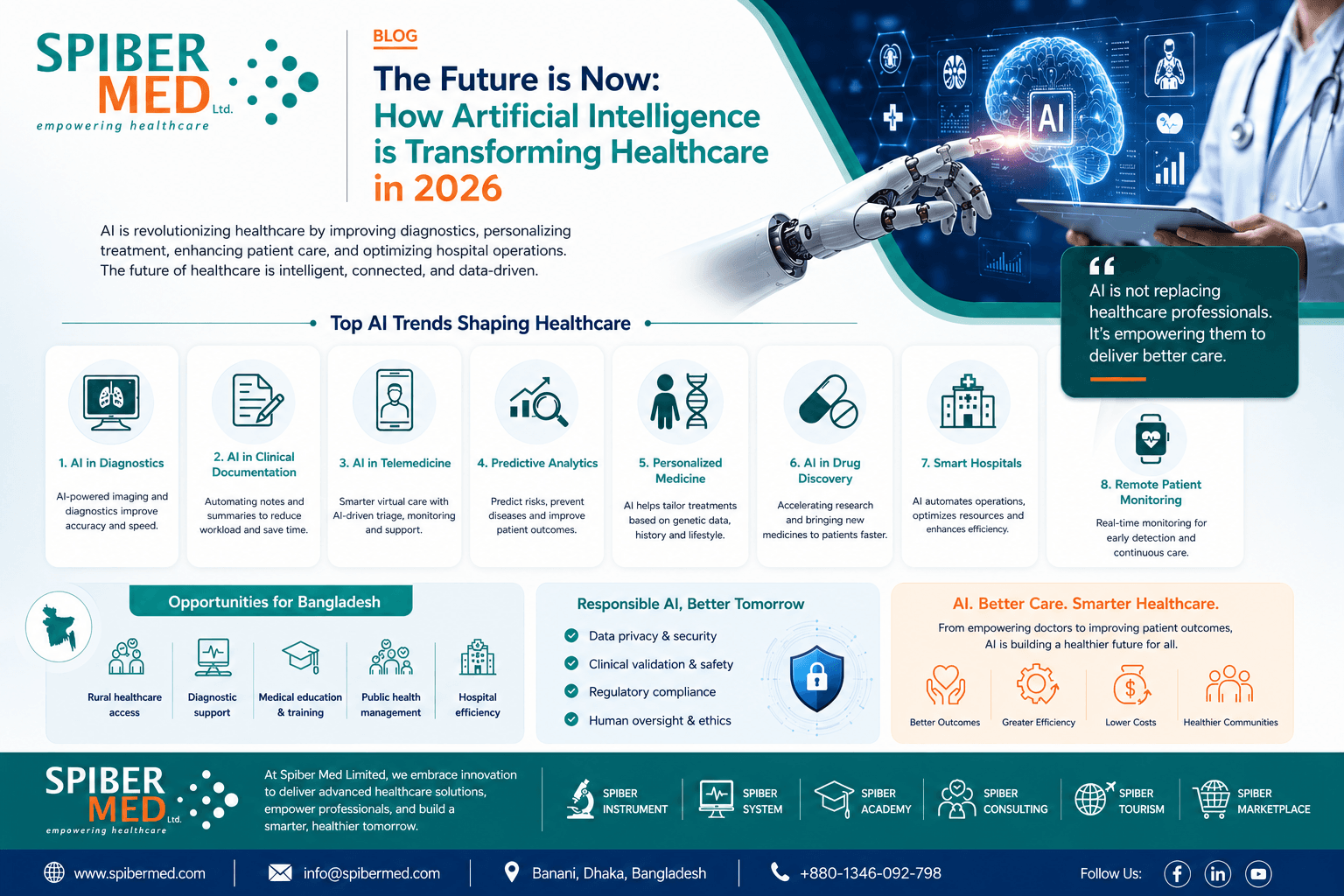
Key AI Trends Transforming Healthcare in 2026
1. AI-Powered Medical Imaging and Diagnostics
Medical imaging remains one of the fastest-growing areas of AI adoption. Advanced AI algorithms can assist radiologists and sonologists in detecting abnormalities in X-rays, CT scans, MRI scans, mammography, and ultrasound images.
Benefits include:
Faster diagnosis
Improved detection accuracy
Reduced reporting time
Early identification of diseases
AI-assisted imaging is increasingly being used to support the detection of conditions such as cardiovascular diseases, lung abnormalities, neurological disorders, and various cancers.
2. Generative AI in Clinical Documentation
One of the biggest challenges faced by healthcare professionals is administrative workload. Generative AI technologies are now helping physicians automate documentation tasks by:
Generating clinical notes
Summarizing patient consultations
Creating discharge summaries
Supporting medical coding
This allows clinicians to spend more time with patients and less time on paperwork.
3. AI-Driven Telemedicine and Virtual Care
The rise of telemedicine has accelerated AI integration into virtual healthcare platforms.
AI-powered systems can:
Conduct preliminary symptom assessments
Schedule appointments
Provide patient education
Support remote monitoring
Assist physicians during virtual consultations
For countries like Bangladesh, AI-enabled telemedicine has enormous potential to improve healthcare access in rural and underserved communities.
4. Predictive Healthcare Analytics
Predictive analytics uses AI to identify potential health risks before they become serious problems.
Healthcare providers can utilize AI to:
Predict disease progression
Identify high-risk patients
Forecast hospital admissions
Optimize resource allocation
Improve preventive healthcare strategies
Early intervention can significantly improve patient outcomes while reducing healthcare costs.
5. Personalized Medicine
Every patient is unique, and AI is helping healthcare move toward more personalized treatment approaches.
By analyzing:
Genetic information
Medical history
Lifestyle factors
Laboratory results
AI can help clinicians develop individualized treatment plans tailored to each patient's specific needs.
This approach is particularly promising in oncology, cardiology, and precision medicine.
6. AI in Drug Discovery and Pharmaceutical Research
Traditional drug development can take over a decade and cost billions of dollars. AI is dramatically reducing the time required to identify promising drug candidates.
AI helps researchers:
Analyze biological data
Predict drug interactions
Identify therapeutic targets
Accelerate clinical trial design
Leading pharmaceutical companies are investing heavily in AI-driven drug development to bring new treatments to patients faster.
7. Smart Hospitals and Healthcare Automation
Hospitals worldwide are embracing AI-powered automation systems to improve operational efficiency.
Examples include:
Intelligent patient flow management
Inventory optimization
Predictive equipment maintenance
Automated appointment scheduling
Workforce planning
These innovations help healthcare facilities reduce costs while improving service quality.
8. AI-Powered Remote Patient Monitoring
Wearable devices and Internet of Medical Things (IoMT) technologies are generating real-time health data.
AI can analyze this information to monitor:
Heart rate
Blood pressure
Blood glucose levels
Oxygen saturation
Sleep patterns
This enables healthcare providers to identify potential health issues before they become emergencies.
Opportunities for Bangladesh
Bangladesh's healthcare sector presents significant opportunities for AI adoption.
Potential applications include:
Rural Healthcare Access
AI-powered telemedicine can connect remote communities with specialists located in major cities.
Diagnostic Support
Healthcare facilities with limited specialist availability can utilize AI-assisted diagnostic tools.
Medical Education and Training
AI-driven learning platforms can support continuous professional development for healthcare workers.
Public Health Management
AI can help monitor disease outbreaks, track epidemiological trends, and support public health planning.
Hospital Efficiency
Healthcare institutions can use AI to optimize operations, improve patient experiences, and reduce administrative burdens.
Challenges and Considerations
While AI offers remarkable opportunities, responsible implementation is essential.
Healthcare organizations must address:
Data Privacy and Security
Patient information must remain protected through robust cybersecurity measures and regulatory compliance.
Clinical Validation
AI tools should undergo rigorous testing and validation before clinical deployment.
Regulatory Compliance
Healthcare providers must ensure adherence to national and international healthcare regulations.
Human Oversight
AI should support—not replace—healthcare professionals. Final clinical decisions must remain under qualified medical supervision.
Ethical AI Usage
Transparency, fairness, and accountability should guide AI implementation across healthcare systems.
The Role of Medical Equipment Companies in the AI Era
Medical equipment providers are increasingly integrating AI capabilities into healthcare technologies.
Modern AI-enabled systems include:
Ultrasound equipment
Diagnostic imaging systems
Patient monitoring devices
Telemedicine platforms
Laboratory automation solutions
Organizations that embrace these innovations will be better positioned to meet the evolving needs of healthcare providers and patients.
How Spiber Med Limited Supports Healthcare Innovation
At Spiber Med Limited, we are committed to supporting healthcare institutions with innovative medical technologies, healthcare solutions, professional training, and digital transformation initiatives.
As AI continues to revolutionize healthcare, we aim to help hospitals, clinics, educational institutions, and healthcare professionals adopt advanced technologies that improve patient care, operational efficiency, and healthcare accessibility.
Through our business divisions—including Spiber Instrument, Spiber System, Spiber Academy, Spiber Consulting, Spiber Tourism, and Spiber Marketplace—we strive to contribute to a smarter, more connected, and technology-driven healthcare ecosystem.
Conclusion
Artificial Intelligence is transforming healthcare at an unprecedented pace. From diagnostics and personalized medicine to telehealth and hospital automation, AI is creating opportunities to deliver safer, faster, and more efficient healthcare services.
The healthcare organizations that invest in AI today will be better prepared to meet the challenges of tomorrow. While AI cannot replace the expertise, empathy, and judgment of healthcare professionals, it can serve as a powerful partner in improving patient outcomes and advancing healthcare innovation.
As we move further into the digital health era, AI will continue to play a critical role in shaping the future of healthcare worldwide.